Introduction
Not every household needs a 72-ounce countertop blender sitting permanently on the counter. For a significant number of people — someone living alone, a student in a small apartment, a professional who blends one smoothie before work each morning — the full-size blender model is simply more machine than the daily routine calls for. It takes up counter space, the cleanup involves more components than necessary for a single serving, and batch capacity that serves six people is irrelevant when the goal is one portable cup of blended fruit before heading out the door.
Personal blenders emerged as a direct response to exactly that mismatch, and the Ninja Fit sits at a well-considered point in that category. At 700 watts with a compact countertop footprint, two 16-ounce to-go cups with spout lids, and the same blade technology Ninja applies across its broader lineup, it’s built for the specific scenario of quick, single-serve blending with minimal setup and cleanup — and then taking the result with you directly in the cup it was blended in.
This article takes a thorough look at what the Ninja Fit actually offers in daily use, how it handles different blending tasks within its intended scope, who it suits best, and what’s genuinely worth understanding before deciding it’s the right blender for your kitchen and your routine.
What Is the Ninja Fit QB3001SS?
The QB3001SS is a personal compact blender produced by Ninja, designed around single-serve blending directly into portable to-go cups rather than a traditional stationary pitcher. The blending mechanism inverts from a conventional blender — rather than blades spinning in the bottom of a pitcher with ingredients poured in from the top, the Ninja Fit’s blade assembly is attached to the motor base and the cup attaches below, blending by spinning downward into the ingredients.
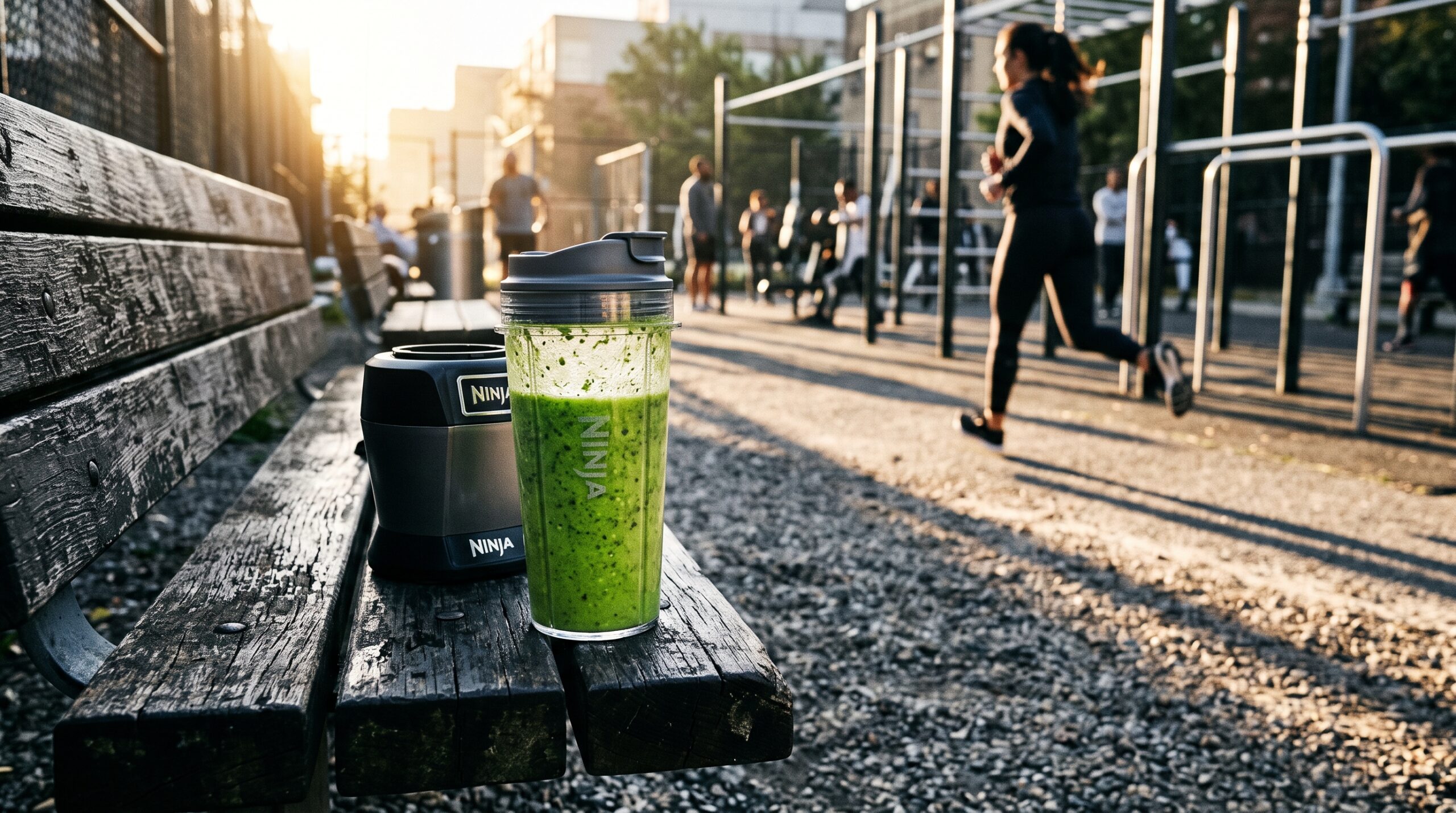
This inverted design is intentional and practical — the cup serves simultaneously as the blending vessel and the drinking container, eliminating the need to transfer blended content from pitcher to cup. Attach a spout lid, and the cup goes directly into your bag or hand for drinking on the way out.
The package includes two 16-ounce cups with spout lids, giving two people the ability to blend separate servings, or one person a second cup for variety or to prepare two days’ servings simultaneously.
Key Features of the Ninja Fit QB3001SS
700-Watt Motor
Seven hundred watts is a meaningful capability level for a personal blender — substantially more powerful than the most basic personal blenders in the 200 to 400-watt range, though less than full-size blenders at 1,000 watts and above. Understanding what this wattage actually delivers in practice requires thinking about the specific tasks a personal blender is typically asked to do.
For the Ninja Fit’s primary use cases — blending fresh fruit, frozen fruit, yogurt, protein powder, leafy greens, and similar smoothie ingredients — 700 watts handles the work effectively. Soft and semi-frozen ingredients blend smoothly without the motor stalling or struggling. Frozen fruit that would overwhelm a 300-watt personal blender gets processed to smooth consistency at 700 watts without extended blending time.
Where the 700-watt ceiling becomes apparent is in tasks that push toward the demanding end of blending — very hard frozen ingredients like large ice cubes, extremely dense combinations with minimal liquid, or dry grinding applications that full-size 1,200-watt blenders handle more comfortably. For everyday smoothie making, the power is more than sufficient. For tasks approaching the limits of what any personal blender is designed for, the capacity ceiling is present and real.
Ninja’s Blade Technology in a Compact Form
The blade assembly in the Ninja Fit uses the same stacked-blade approach that characterizes Ninja’s broader blender lineup — multiple blade tiers designed to process ingredients at different heights simultaneously rather than relying on a single cutting surface at the cup’s bottom.
In a personal blender cup where the entire blending volume is relatively small, this multi-blade approach creates more thorough processing throughout the 16-ounce space than a single blade would. Ingredients circulate through multiple cutting zones, producing smoother results faster than single-blade designs at comparable wattage levels. Frozen fruit breaks down more completely. Leafy greens get processed rather than leaving leaf fragments. Fibrous ingredients like ginger or celery blend into the mix rather than remaining in visible pieces.
Two 16-Ounce To-Go Cups with Spout Lids
The two included cups are central to the Ninja Fit’s practical value proposition. Each holds 16 ounces — a standard single-serve smoothie portion that fits in most car cup holders, bike bottle cages, and bag side pockets. The to-go cups are the blending vessels, the serving containers, and the drinking cups simultaneously, which eliminates the pitcher-to-cup transfer step that adds both time and cleanup to a conventional blender workflow.
The spout lids attach after blending, turning each cup into a travel-ready drinking container. The spout design allows for controlled sipping without the wide-open top of a standard blender cup that would spill when tilted. For drinking while commuting, exercising, or simply moving through a morning routine, the spout lid design suits the use case directly.
Having two cups in the package serves multiple purposes. Two household members can blend their own smoothies independently without waiting for one cup to be washed before the other can be used. Alternatively, a single user can prepare two separate blends — perhaps one for immediate consumption and one stored in the refrigerator for the following morning — without washing between sessions.
Compact Countertop Footprint
The Ninja Fit’s small base size is a defining characteristic that matters for the kitchen environments where it typically lives. Dorm rooms, small apartment kitchens, office desk areas, RV kitchens, and any space where counter real estate is genuinely limited all benefit from an appliance that occupies minimal space without sacrificing functional capability.
The motor base is proportioned to the single-serve cup format — it’s not a scaled-down full-size blender, but a design built from the ground up around the compact personal use case. The height of the assembled blender with cup attached is considerably shorter than a full-size pitcher blender, which also helps with overhead cabinet clearance that can be an issue for taller countertop appliances.
Simple Single-Button Operation
The Ninja Fit’s operation is as straightforward as any blender on the market. Load the cup with ingredients, attach it to the motor base, press and hold the button, and blend until the desired consistency is reached. Release the button to stop. Detach the cup, attach the spout lid, and go.
There are no speed settings to navigate, no preset programs to understand, and no digital displays to interpret. The manual pulsing action — blend for as long as the button is held, stop when it’s released — gives the user intuitive control over blending duration without any interface complexity. For an appliance used first thing in the morning when cognitive overhead is minimal, this simplicity is a genuine virtue rather than a limitation.
Black Finish
The classic black finish is neutral and kitchen-appropriate across a range of environments — the color works in a modern kitchen, a college dorm, an office break room, or a home gym area with equal ease. Black appliances show less visible residue between cleanings than white, and the finish gives the compact unit a more substantial appearance than lighter-colored alternatives at the same size.
How the Ninja Fit Can Be Used
Morning Smoothies for One
This is the Ninja Fit’s defining use case and where it performs most naturally. The routine is efficient by design — add frozen fruit, fresh fruit, a handful of spinach or kale if preferred, yogurt, milk or a dairy alternative, and any other smoothie ingredients directly into the cup, attach the cup to the base, blend for 20 to 30 seconds, attach the spout lid, and leave. Total time from ingredient loading to ready-to-drink: under two minutes. Total cleanup: rinse the cup and blade attachment with warm water.
For someone who makes a smoothie every morning and values both the nutrition and the time efficiency, this workflow removes every friction point from the daily habit — no pouring from pitcher to cup, no large pitcher to wash, no waiting for multiple components to be ready.
Protein Shakes and Post-Workout Drinks
Protein powder mixed with liquid and blended rather than shaken produces a smoother, better-integrated result — no clumps of powder, no gritty texture from incompletely dissolved protein. The Ninja Fit handles this naturally, and the 16-ounce cup is sized appropriately for a standard protein shake serving.
The portability of the finished shake in the same cup it was blended in suits the post-workout context particularly well — blend immediately after training while still at the gym bag, and drink on the way home without any separate container required.
Frozen Drinks and Slushies
Within its 700-watt capability range, the Ninja Fit handles softer frozen drink applications — blended lemonade, fruit slushies, simple frozen cocktails when made with appropriate ice quantities. Crushed ice or smaller ice pieces blend more effectively than whole standard ice cubes in a personal blender, and adding adequate liquid ensures the motor isn’t working against dry resistance.
For very ice-heavy frozen cocktails or large quantities of hard ice, a more powerful full-size blender produces more reliable results. For lighter frozen drink applications, the Ninja Fit covers the need.
Nut Milk Preparation
Blending soaked nuts with water to make small quantities of homemade almond milk, cashew milk, or oat milk is achievable in the Ninja Fit for a single-serving quantity. The result can then be used directly in coffee, poured over cereal, or consumed as a beverage. For someone who uses nut milk daily but in modest single-serve quantities, blending fresh each time in the Ninja Fit is more practical than making large batches in a full-size blender.
Baby Food and Single-Serving Purees
For parents preparing homemade baby food in single-serving quantities rather than large batches, the Ninja Fit’s cup size is appropriately scaled. Steamed vegetables blended to smooth puree consistency, fruit combinations pureed for early eating stages, and similar preparations fit naturally within the 16-ounce cup without the wasteful excess of blending large batches that won’t be consumed.
Salad Dressings and Single-Serve Sauces
The Ninja Fit handles liquid-based mixing tasks like dressings and simple sauces effectively. A vinaigrette blended smooth, a quick tahini sauce, or a single-serve pesto — small quantities that don’t justify the setup and cleanup of a full-size blender blend efficiently in the personal cup.
Pre-Prepared Smoothie Storage
Preparing a smoothie the night before for a morning where time is even more compressed than usual is a practical use of the Ninja Fit’s cup design. Blend the smoothie, attach the lid, and refrigerate the sealed cup overnight. In the morning, grab it from the refrigerator and go. The spout lid keeps the smoothie fresh overnight without any transfer required.
Who the Ninja Fit May Be Suitable For
Individuals Living Alone
A single-person household has no use for a blender that produces six servings at a time. The Ninja Fit is proportioned for exactly one serving and sized for spaces where one person’s kitchen equipment needs are the entire consideration. For someone living alone who blends regularly, the Ninja Fit produces the right quantity with the right footprint.
Students in Dorms and Small Apartments
College students represent one of the clearest fits for the Ninja Fit’s combination of compact size, simple operation, and affordable price point. Dorm room counter space is extremely limited. The blender can sit beside a mini refrigerator without dominating the available surface. The to-go cup design suits a campus lifestyle where breakfast is consumed while walking to class. And the cleanup simplicity suits a living situation where elaborate washing routines are impractical.
Working Professionals with Compressed Morning Routines
For someone who wakes up, makes a smoothie, and leaves for work within 30 minutes, the Ninja Fit’s workflow efficiency is directly valuable. The elimination of pitcher-to-cup transfer and the minimal cleanup afterward compresses the morning smoothie routine to something that genuinely fits within a busy pre-work schedule without cutting corners on nutrition.
People in RVs, Vans, or Small Living Spaces
Mobile and compact living situations have severe space constraints that make full-size blenders impractical even when regular blending is desired. The Ninja Fit’s compact base, small footprint, and self-contained cup design suit these environments in a way that larger appliances simply don’t.
Secondary Blender for Larger Households
In households that have a full-size blender for batch cooking but also want a quick, low-cleanup option for individual daily smoothies, the Ninja Fit fills the secondary role efficiently. Rather than running and cleaning the full-size blender for a single 16-ounce smoothie, the Ninja Fit handles that individual serving with a fraction of the effort.
Health-Conscious Commuters
Someone who blends a nutrient-dense smoothie each morning as a foundational part of their health routine and needs to consume it on the go benefits from the Ninja Fit’s design in a way that conventional blenders don’t directly support. The to-go cup is the complete solution — blend, lid, go.
People New to Regular Blending
For someone establishing a new smoothie or blending habit and not yet certain it will become a permanent routine, the Ninja Fit’s lower price point compared to full-size blenders makes it a reasonable commitment level. If the habit sticks, a potential upgrade to a larger machine can be considered with confidence. If it doesn’t, the investment was proportionate to the uncertainty.
Important Things to Consider
16 Ounces Is the Maximum Capacity
The 16-ounce cup size is both a defining feature and a hard limit. It’s enough for one generous smoothie serving but not enough for two. For households where blending for multiple people simultaneously is regularly needed, two separate blending cycles are required — or a larger machine is the more practical tool. The two included cups help with this for two-person households, but each still requires a separate blending cycle.
Fill Level Matters for Performance
Like all personal blenders, the Ninja Fit performs best when the cup is filled appropriately — enough ingredients to engage the blades properly, but not so full that the motor is working against an overpacked cup. Following Ninja’s fill line guidelines and ensuring adequate liquid is present for the ingredients being blended produces better results than pushing to the absolute maximum fill level.
Hard Ice and Very Dense Combinations Have Limits
The 700-watt motor handles a wide range of smoothie ingredients effectively, but very hard whole ice cubes, very dense fibrous combinations with minimal liquid, and dry grinding tasks approach the upper edge of what a personal blender at this power level handles comfortably. Crushed ice works better than whole cubes, adequate liquid is essential, and reasonable ingredient combinations produce reliable results. Pushing the machine toward its limits produces less consistent outcomes.
Single-Speed Manual Operation Means Technique Matters
Without variable speed settings, the user controls blending through duration — how long the button is held. Getting a feel for how long different ingredient combinations need is something that develops over the first few uses rather than being guided by preset programs. For most smoothie applications, 20 to 30 seconds of blending is adequate, but this varies with ingredient density and frozen content.
Not Suitable for Hot Liquids
Personal blenders with sealed cups are not designed for hot liquid blending. The sealed cup creates a pressure buildup risk with hot contents that makes this genuinely unsafe. The Ninja Fit is intended for cold and room-temperature ingredients — blending hot soups or heated liquids requires a full-size blender with a vented lid or an immersion blender.
Blade Assembly Requires Care in Cleaning
The blade assembly that attaches to the motor base is sharp and requires careful handling during cleaning. A bottle brush or careful hand washing rather than rough scrubbing handles cleaning effectively while avoiding contact with the blades. Some users blend a small amount of warm soapy water immediately after use to clean the interior of the cup before rinsing.
How the Ninja Fit Compares to Other Options
Ninja Fit vs. Ninja Professional Blender 2.0
The most relevant Ninja-internal comparison is between the Fit’s personal blending approach and the Professional Blender 2.0’s 72-ounce full-size design. The difference isn’t primarily about quality — it’s about purpose. The Professional Blender 2.0 serves multiple people, handles batch blending, and accommodates more demanding applications at 1,200 watts. The Ninja Fit serves one person, minimizes setup and cleanup, and fits where a full-size blender doesn’t. For households where both needs exist — family batch blending and individual daily smoothies — having both machines serves different moments in the cooking routine. For a single-person household that only ever blends one serving at a time, the Ninja Fit is more proportionate and practical.
Ninja Fit vs. NutriBullet Personal Blenders
The NutriBullet line is the most direct competitor in the personal blender category, operating on essentially the same inverted-blade, blend-in-cup principle. Both brands offer models at similar wattage levels with comparable to-go cup designs. Performance between well-matched models from both brands is broadly similar for everyday smoothie applications. The choice between them often comes down to specific accessories included, cup size preferences, and design preference rather than meaningful performance differences at comparable price and wattage points.
Ninja Fit vs. Full-Size Blenders From Other Brands
Against any full-size blender with a traditional pitcher design, the Ninja Fit trades blending power, batch capacity, and functional versatility for compactness, portability, and workflow simplicity. The comparison is less about which is better and more about which is appropriate for a given household’s needs. For the specific scenario the Ninja Fit is designed for — one person, one serving, minimal time and cleanup — it outperforms a full-size blender in practical terms even though the full-size machine is technically more capable.
Ninja Fit vs. Immersion Blenders
Immersion or stick blenders blend in any container and handle a range of tasks including hot soups, sauces, and dressings that the Ninja Fit can’t approach due to the sealed cup limitation. Immersion blenders are extremely compact and versatile. The trade-off is that they don’t handle frozen ingredients as effectively and the to-go cup convenience isn’t available. For households that primarily want blending capability for soups, sauces, and cooking applications, an immersion blender is often more relevant. For frozen smoothie and to-go drink preparation, the Ninja Fit suits the use case more directly.
Frequently Asked Questions
Can I blend leafy greens like spinach and kale in the Ninja Fit?
Yes. Soft leafy greens like spinach blend almost completely at 700 watts when adequate liquid is present. Kale, which has tougher leaves and fibrous stems, blends better when the stems are removed and the leaves are torn rather than whole. Adding liquid first, then greens, then frozen fruit produces better blade engagement than loading in the reverse order.
How long should I blend for a typical smoothie?
Most smoothie combinations blend to smooth consistency in 20 to 40 seconds of continuous blending. Combinations with more frozen content may need slightly longer. The personal judgment of blending until resistance decreases and the sound of the motor smooths out is a reliable guide alongside the timer.
Are the cups dishwasher safe?
The cups and lids are generally listed as dishwasher safe on the top rack. The blade assembly benefits from hand washing to maintain sharpness and integrity over time and to avoid contact with the blades during dishwasher loading and unloading. Checking the current product documentation for specific cleaning guidance is always recommended.
Can I use the cups in the freezer to pre-freeze smoothie packs?
Yes. Preparing smoothie ingredient packs — measured and combined ingredients — and freezing them in the Ninja Fit cups is a practical meal prep approach. Allow the frozen pack to thaw slightly before blending, add liquid, and blend as normal. This prep approach reduces morning routine time even further for people who plan their smoothies in advance.
Is the Ninja Fit suitable for making nut butter?
The Ninja Fit’s 700-watt motor and 16-ounce cup are not well suited to nut butter production, which requires sustained high-power processing of very dense dry ingredients with minimal liquid. Nut butter is better handled by a full-size high-powered blender or a dedicated food processor. The Ninja Fit handles nut-containing smoothies comfortably, but nut butter as a finished product is outside its practical range.
Can I blend protein powder directly in the cup?
Yes, and this is one of the most common applications. Add liquid first, then protein powder and other ingredients, and blend for 15 to 20 seconds. The blending produces a smoother, better-integrated result than shaking in a separate shaker cup, with no clumping.
How durable are the to-go cups over time?
The cups are made from BPA-free plastic and hold up well to regular use and cleaning with reasonable care. Avoiding abrasive scrubbing that scratches the plastic and not exposing cups to very high dishwasher temperatures extends their life. Replacement cups are available for purchase if cups become worn or damaged over time.
What’s the maximum amount of frozen fruit I can blend?
A rough guideline is filling no more than half the cup with frozen ingredients, with adequate liquid to create the vortex the blades need. Very dense combinations of predominantly frozen content with minimal liquid strain the motor and produce inconsistent results. Starting with more liquid and adjusting to preference over subsequent uses develops intuition for the right balance.
Conclusion
The Ninja Fit Compact Personal Blender earns its place in the market by being exactly what it claims to be — a compact, capable, to-go-ready single-serve blender that removes friction from the daily smoothie routine for the specific audience it’s designed to serve. Seven hundred watts handles the everyday blending tasks of frozen fruit, leafy greens, yogurt, and protein powder without the struggles of underpowered personal blenders. The inverted cup design eliminates the pitcher-to-cup transfer that adds unnecessary steps to a simple daily routine. The spout lid turns the blending vessel directly into a portable drinking container. And the minimal footprint fits into living situations and kitchen spaces where full-size blenders are impractical.
Its limitations are equally clear and worth acknowledging honestly. The 16-ounce capacity serves one person per blending cycle. Hard whole ice cubes and very dense combinations push toward the edge of what 700 watts handles comfortably. Hot liquid blending is not safe with the sealed cup design. And the absence of variable speed settings means blending duration is the primary control variable rather than speed adjustment.
Within its intended scope — quick, portable, single-serve blending for individuals and small households who value efficiency and compactness over batch capacity and maximum power — the Ninja Fit delivers a well-considered, practically designed solution that genuinely fits the daily routine it was built for.