Introduction
Blenders occupy an interesting position in the kitchen appliance hierarchy. On one hand, almost every household has one — or has had one at some point. On the other hand, the quality gap between a basic blender that struggles with anything harder than a ripe banana and a genuinely capable machine that handles ice, frozen fruit, fibrous vegetables, and whole nuts without complaint is enormous. That gap explains why blender disappointment is so common, and why households that upgrade to a more capable machine often wonder how they tolerated the previous one for so long.
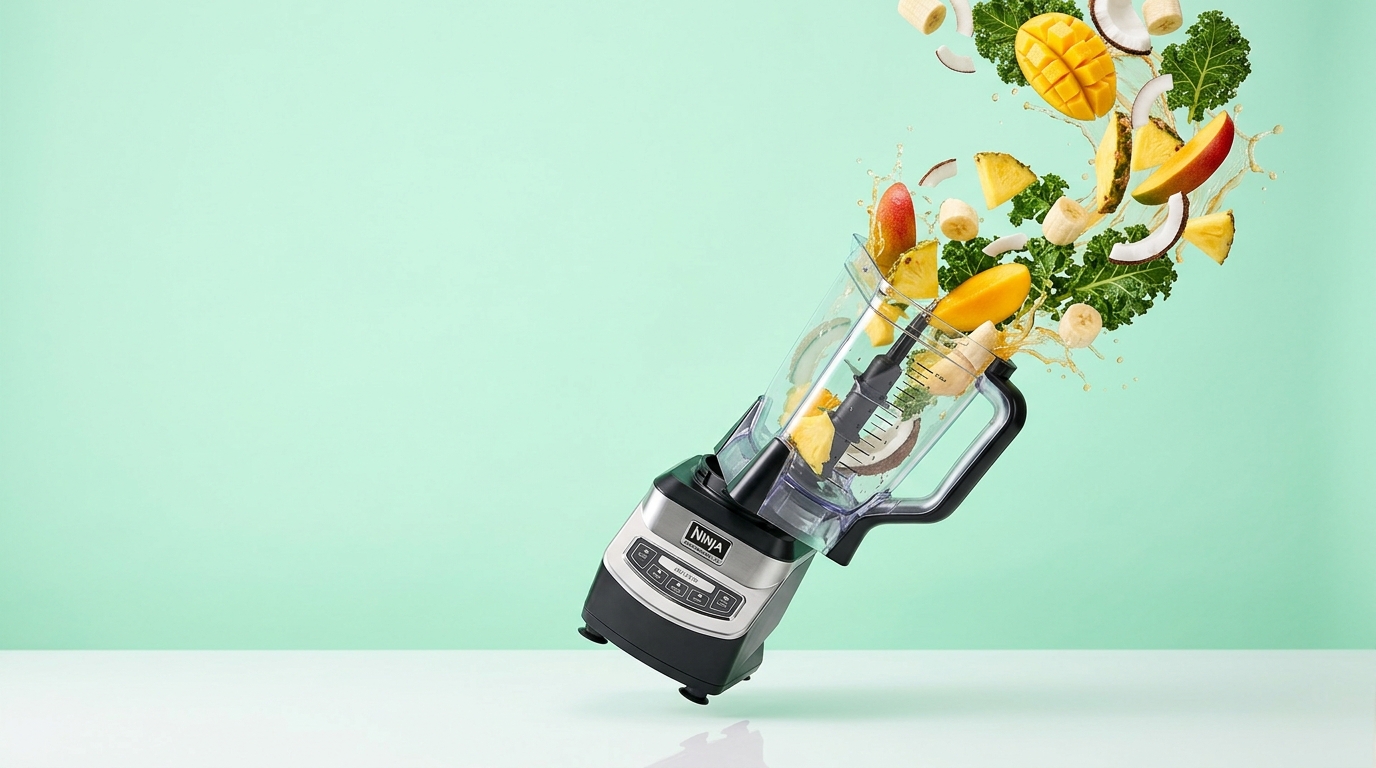
The Ninja Professional Blender 2.0 sits in a category designed to close that gap without requiring a commercial-grade investment. At 1,200 watts with Total Crushing Technology and an Auto-iQ program, it’s built around the idea that serious blending capability shouldn’t be the exclusive territory of professional kitchens or high-end home setups. The XL 72-ounce pitcher accommodates family-sized batches, the dark grey finish works in most kitchen environments, and the feature set covers the range of tasks that everyday households actually need from a blender — smoothies, frozen drinks, grinding, ice crushing, and more.
This article takes a thorough, honest look at what the Ninja Professional Blender 2.0 offers, how its technology actually functions across different blending tasks, who it’s genuinely suited to, and what’s worth understanding before deciding whether it earns a place in your kitchen.
What Is the Ninja Professional Blender 2.0?
The BR201AMZ is a full-size countertop blender produced by Ninja, positioned in the brand’s professional blender segment — above entry-level personal blenders and single-serve models, but at a more accessible price point than Ninja’s ultra-premium lines. The “2.0” designation signals this as an updated iteration of the Professional Blender concept, incorporating Ninja’s Auto-iQ intelligent blending programs alongside the manual speed and pulse controls that defined earlier models.
The combination of 1,200 watts of motor power, Total Crushing Technology blade design, and intelligent Auto-iQ programming gives the BR201AMZ a capability profile suited to demanding blending tasks that cheaper machines handle poorly or not at all — ice crushing, frozen fruit blending, hard ingredient processing, and creating smooth, consistent textures from challenging raw materials.
The 72-ounce XL pitcher is a meaningful capacity choice that distinguishes this from single-serve and personal blenders — it’s built for batch blending that serves multiple people or produces enough for storage.
Key Features of the Ninja Professional Blender 2.0
1,200-Watt Motor
Motor power is the foundation of blending performance, and 1,200 watts represents a meaningful capability threshold in the countertop blender market. To understand why wattage matters, it helps to think about what a blender is actually doing when it encounters a challenge — it’s spinning blades through resistant material. Ice cubes, frozen fruit, raw almonds, fibrous kale stems, and similar ingredients resist blade movement. An underpowered motor slows, heats up, and ultimately either stalls or produces inconsistent results because it can’t maintain blade speed through the resistance.
At 1,200 watts, the Professional Blender 2.0 maintains blade velocity through dense, hard, and frozen ingredients in a way that 500 to 700-watt machines simply cannot. The motor doesn’t bog down when frozen fruit enters the blend or when ice cubes encounter the blades at full speed. This sustained power is what produces smooth results from difficult ingredients rather than chunky, inconsistently processed textures.
For everyday tasks like blending soft fruit smoothies or mixing liquid ingredients, 1,200 watts is more than adequate — the motor handles these tasks easily. The power reserve becomes relevant when the ingredients get challenging, and having that reserve available means the blender doesn’t become the limiting factor in what you can make.
Total Crushing Technology
The blade system in the Professional Blender 2.0 is built around what Ninja calls Total Crushing Technology — a stacked blade design with multiple blade tiers at different heights within the pitcher rather than a single blade level at the bottom.
Standard single-blade blenders have one cutting surface working at the base of the pitcher. Food that lands on this blade gets processed; food that floats above it circulates before eventually making its way down. The result is often inconsistent — some material well processed, other pieces still in larger chunks, requiring repeated stopping and stirring to coax everything through the blade zone.
Ninja’s stacked blade design creates multiple processing zones simultaneously throughout the column of liquid and ingredients in the pitcher. Material at different heights encounters blades at its level rather than needing to migrate to the bottom first. The vortex created by the spinning pulls ingredients down and into the blade zones continuously, and the multiple processing heights mean the entire contents of the pitcher are being actively processed rather than just the material near the bottom.
The practical result is more consistent textures achieved more quickly, with less need for stopping, stirring, and restarting — and better ice crushing, since ice encountered at multiple heights gets processed more efficiently than ice that must all find its way to a single blade level.
Auto-iQ Intelligent Blending Programs
Auto-iQ is Ninja’s name for their programmed blending intelligence — preset combinations of speed levels, pulsing patterns, and timing sequences that the machine executes automatically when selected. Rather than requiring the user to manually manage speed adjustments throughout a blending cycle, Auto-iQ programs run a predetermined sequence designed to produce optimal results for a specific blending task.
Different tasks benefit from different blending approaches. A smoothie blends most effectively with a sequence that starts at lower speed to incorporate air, ramps up to full power to break down frozen ingredients, and uses pulsing patterns to create the vortex that pulls fruit down into the blades continuously. Ice crushing for frozen drinks benefits from aggressive pulsing at high speed rather than sustained blending. These nuances would require manual management in the absence of preset programs.
Auto-iQ removes that management requirement. Select the appropriate program, press start, and the machine executes the optimized sequence for that task automatically — stopping when the cycle is complete. For users who want consistent results without learning the manual technique of blending different ingredients optimally, Auto-iQ is the feature that delivers that consistency.
XL 72-Ounce Pitcher
The 72-ounce pitcher capacity is a defining characteristic of the Professional Blender 2.0 and the reason it suits family-sized batch blending rather than single-serve preparation. Seventy-two ounces translates to 9 cups — enough for four to six smoothie servings, a large batch of frozen margaritas for a group, or a substantial quantity of soup or sauce that can be divided and stored.
For households where blending is a daily routine for multiple people — a family making smoothies before work and school, a household batch-blending protein shakes for the week, or hosts making cocktails for a gathering — the 72-ounce capacity means fewer batches and more from each blending session.
The pitcher is made from BPA-free plastic, balancing the lighter weight and durability of plastic against glass’s visual clarity. The large capacity does mean the blender is a substantial countertop presence — both the footprint and the height of the pitcher on the base require adequate counter and overhead cabinet clearance.
Multiple Manual Speed Settings with Pulse
Alongside the Auto-iQ programs, the Professional Blender 2.0 maintains manual speed control — multiple speed settings that allow the user to manage the blending process directly when precision or specific outcomes require it. The pulse function provides momentary bursts of full power for controlled chopping, breaking up large chunks before sustained blending, or finishing textures at precise moments.
Manual control suits experienced blenders who have developed intuition for how specific ingredients behave, or tasks where the Auto-iQ program isn’t the right fit — making a chunky salsa where texture control matters, for instance, or incorporating delicate ingredients that don’t need aggressive processing.
The combination of Auto-iQ and manual controls gives the BR201AMZ flexibility across both automated and hands-on blending approaches, suiting both users who want simplicity and those who want control.
Dark Grey Finish
The dark grey exterior gives the Professional Blender 2.0 a contemporary, understated look that fits most kitchen aesthetics. Dark finishes show smudges and water spots less readily than white or stainless, which matters for a countertop appliance used daily. The design is professional without being flashy — it sits naturally alongside other kitchen equipment without demanding visual attention.
How the Ninja Professional Blender 2.0 Can Be Used
Daily Smoothies and Protein Shakes
This is the most common daily use for most blender-owning households, and the Professional Blender 2.0 handles it comprehensively. Frozen fruit blends smoothly without the chunks and stringy fibrous bits that underpowered blenders leave behind. Spinach and kale break down completely rather than remaining in identifiable leaf pieces. Ice incorporates fully rather than floating above a watery base.
The 72-ounce pitcher makes family morning smoothie production realistic in a single blend — enough for four to five servings produced simultaneously rather than running the blender two or three times while early batches sit and separate.
The Auto-iQ smoothie program handles the blending sequence automatically — start it, walk away and prepare other breakfast elements, return to a finished batch ready to pour.
Frozen Cocktails and Blended Drinks
Margaritas, daiquiris, piña coladas, frozen lemonades — blended drinks for gatherings or entertaining require ice crushing capability that basic blenders don’t reliably provide. Total Crushing Technology processes ice into the fine, even texture that produces proper slushy cocktail consistency rather than large ice chunks swimming in partially blended liquid.
The 72-ounce capacity is particularly relevant here. Making frozen cocktails for a group of four to six in a single pitcher batch rather than running the blender repeatedly while hosting is a practical advantage during entertaining.
Crushing Ice for Drinks and Food Applications
Beyond cocktails, ice crushing serves standalone purposes — crushed ice for drinks, snow-cone-style desserts, cold brewing applications, and various culinary uses where ice texture matters. The Professional Blender 2.0’s ice crushing capability at 1,200 watts produces consistently fine, even crushed ice rather than the uneven, partially crushed output that lower-powered machines deliver.
Grinding Nuts, Seeds, and Grains
The motor power and blade design make the Professional Blender 2.0 capable of grinding applications that single-purpose blenders can’t handle. Whole almonds, cashews, flaxseeds, chia seeds, oats, and similar hard dry ingredients can be processed into flour, meal, or butter consistency depending on duration and technique.
Homemade almond flour, oat flour for baking, ground flaxseed for nutrition additions, and nut butter bases are all achievable in the Professional Blender 2.0 — functions that would otherwise require a separate food processor or dedicated nut grinder for reliable results.
Blending Hot Soups and Sauces
Transferring cooked vegetables and broth into the pitcher for blended soup is a common and effective use of a full-size blender. Butternut squash soup, tomato bisque, roasted red pepper sauce, and similar preparations blend to velvety smooth consistency in the 72-ounce pitcher. The large capacity accommodates a substantial batch of soup — enough for a family dinner with leftovers in a single blend rather than working in multiple small batches.
Important caution with hot liquids — filling the pitcher no more than halfway and holding the lid firmly while starting at low speed prevents pressure buildup and potential hot liquid eruption, a standard safety precaution with any blender used for hot ingredients.
Making Nut Milks and Dairy Alternatives
Blending soaked almonds, cashews, or oats with water and then straining the result produces homemade nut or oat milk — an increasingly popular approach for households that consume large quantities of dairy alternatives and want cost control and ingredient transparency. The Professional Blender 2.0’s power produces finely processed nut milks that strain cleanly, with less unprocessed particulate than lower-powered blenders leave behind.
Hummus, Dips, and Thick Spreads
The pulse function and manual speed controls make the Professional Blender 2.0 useful for thick dips and spreads — hummus, guacamole, pesto, and similar preparations where texture control matters more than pure smoothness. The large pitcher accommodates batch sizes appropriate for a gathering or a week’s supply of homemade hummus stored in the refrigerator.
Baby Food and Purees
For households with infants, the Professional Blender 2.0 handles pureed baby food production effectively — steamed vegetables and fruits blended with cooking water to appropriate consistencies. The power ensures complete processing of fibrous vegetables into smooth purees appropriate for early feeding stages, and the 72-ounce pitcher allows meaningful batch production for freezing in portions.
Who the Ninja Professional Blender 2.0 May Be Suitable For
Families with Multiple Daily Blender Users
The 72-ounce pitcher and 1,200-watt power make the BR201AMZ particularly well suited to households of three to five people who blend regularly — morning smoothies, post-workout shakes, or other daily blending routines that require volume and consistency across multiple servings simultaneously.
Smoothie and Frozen Drink Enthusiasts
Households where smoothies are a serious daily habit — not just occasional — benefit most from the capability and consistency the Professional Blender 2.0 provides. The difference between a $50 blender and this machine becomes most apparent over hundreds of uses with challenging ingredients, where underpowered machines produce progressive frustration.
Home Entertainers
For hosting situations where blended cocktails, large-batch smoothies, or fresh drinks are part of the hospitality offering, the combination of capacity and ice crushing power makes the Professional Blender 2.0 a genuinely useful tool rather than a machine that struggles to keep up with demand.
Health-Conscious Households
People who regularly blend vegetables, leafy greens, seeds, nuts, and other nutrient-dense ingredients for health purposes benefit from the motor power that processes these challenging ingredients completely rather than partially. A kale smoothie where the kale is actually fully processed rather than in green leaf fragments is a meaningfully different drink — and the Professional Blender 2.0 consistently produces the former.
People Upgrading from Underpowered Blenders
For households that have tolerated a basic blender’s limitations — chunky smoothies, inadequate ice crushing, stalling on frozen fruit — and are ready for the experience of a capable machine, the BR201AMZ represents a performance upgrade that makes the difference immediately apparent.
Home Cooks Who Want Reduced Appliance Count
The blending, grinding, and crushing capability of the Professional Blender 2.0 covers functional territory that otherwise might require a dedicated food processor, a nut grinder, and a blender separately. For kitchens trying to consolidate equipment without sacrificing capability, the breadth of what the BR201AMZ handles in a single appliance has genuine value.
Important Things to Consider
Size and Counter Clearance
The 72-ounce pitcher on the motor base is a tall combination. Standard kitchen cabinet clearance — typically 18 inches between counter and cabinet bottom — may be insufficient for the fully assembled blender in some kitchens. Measuring available height before purchasing prevents the frustrating discovery that the blender doesn’t fit under the cabinets where it was intended to live.
Noise Level
At 1,200 watts, the Professional Blender 2.0 is not a quiet appliance. High-power blending at full speed produces significant noise — comparable to other full-size high-powered blenders at this wattage level. In apartments with thin walls or shared living situations, or for early morning blending when household members are sleeping, the noise is a genuine consideration. Shorter blending cycles through efficient processing reduce noise duration if not intensity.
Cleaning the Stacked Blade System
The multi-blade stacked assembly that makes Total Crushing Technology effective is also more involved to clean than a simple single-blade setup. The blades are sharp and require careful handling during cleaning. Many users blend a mixture of warm water and dish soap in the pitcher immediately after use to clean the interior quickly, then rinse thoroughly. The pitcher is typically top-rack dishwasher safe, but the blade assembly benefits from careful hand cleaning to reach all surfaces effectively.
Not a Dedicated Food Processor
While the Professional Blender 2.0 handles many tasks that overlap with food processor functions — grinding, chopping, pureeing — it’s not a complete replacement for a dedicated food processor for tasks like slicing, shredding, or dough making. Understanding the boundary of what the blender handles well versus what requires a food processor sets realistic expectations.
Liquid Required for Most Blending
Like all countertop blenders, the Professional Blender 2.0 requires adequate liquid for effective blending. Dry ingredients alone don’t blend — they circulate and bounce off the blades without proper liquid to create the vortex that processes ingredients consistently. Adding sufficient liquid is fundamental to getting good results from any blending task.
Pitcher Fill Level for Hot Liquids
When blending hot soups or sauces, filling the pitcher no more than halfway prevents steam pressure buildup that can force the lid off and spray hot liquid. Starting at low speed, holding the lid with a folded towel, and building speed gradually handles hot liquid blending safely.
How the Ninja Professional Blender 2.0 Compares to Other Options
Professional Blender 2.0 vs. Personal Single-Serve Blenders
Personal blenders — including Ninja’s own single-serve lines — are designed for one portion at a time, typically blending directly into a portable cup. They suit individuals blending for themselves and prioritize compactness and portability over batch capacity. The Professional Blender 2.0’s 72-ounce pitcher is designed for family-sized batches and batch blending rather than individual servings. For households of multiple people or anyone who regularly blends more than a single serving, the full-size pitcher is more practical. For solo users who blend one portion at a time, a personal blender is often more efficient.
Professional Blender 2.0 vs. Entry-Level Blenders
The practical performance gap between the Professional Blender 2.0 and basic 500 to 700-watt entry-level blenders is significant and noticeable in daily use. Entry-level machines struggle with frozen fruit, can’t reliably crush ice, and produce inconsistent textures with fibrous or hard ingredients. The 1,200-watt motor and Total Crushing Technology handle these tasks without the stopping, stirring, and repeated processing that lower-powered machines require. For households that blend challenging ingredients regularly, the performance difference is not marginal.
Professional Blender 2.0 vs. Vitamix and High-End Blenders
Premium blenders from brands like Vitamix and Blendtec represent the upper end of home blending performance — motors of 1,500 to 2,200 watts, variable speed control with very fine increments, commercial-grade components, and price points that reflect that engineering. The Professional Blender 2.0 at 1,200 watts doesn’t quite match the absolute performance ceiling of these machines — particularly for the smoothest possible nut butters, the finest flours, and the most demanding daily professional-level use. For households that blend extensively, find the results from the Ninja insufficient, and can justify the price premium, a Vitamix represents the next tier. For most home households, the Professional Blender 2.0 provides more than adequate performance at a considerably more accessible price.
Professional Blender 2.0 vs. Food Processors
Food processors and blenders overlap in some functional territory but are optimized for different tasks. Food processors excel at slicing, shredding, dicing, and dough processing through interchangeable blade and disc attachments. Blenders excel at liquid-based processing — smoothies, soups, sauces, and anything requiring vortex-based blending. The Professional Blender 2.0 handles some food processor territory through grinding and chopping, but doesn’t replace a food processor for slicing and shredding. They’re complementary tools rather than substitutes for each other.
Frequently Asked Questions
Can the 72-ounce pitcher go in the dishwasher?
The pitcher is generally listed as top-rack dishwasher safe. The blade assembly benefits from careful hand washing to clean all surfaces effectively and maintain blade sharpness over time. Checking the current product documentation for specific cleaning guidance is recommended, as care instructions can be updated.
How does Auto-iQ know when blending is complete?
Auto-iQ programs run predetermined time sequences — specific durations of blending, pulsing, and pausing — rather than sensing ingredient consistency in real time. The programs are developed and calibrated to produce good results for their intended tasks within typical ingredient quantities and types. For unusual ingredient combinations or very different quantities, manual adjustment may produce better results than relying solely on the preset timing.
Can I blend hot soup directly in the pitcher?
Yes, with important safety precautions. Fill the pitcher no more than halfway with hot liquid, remove the center cap from the lid or hold the lid firmly with a folded towel, start at the lowest speed, and build up gradually. Never seal the lid completely with hot liquid inside — steam pressure requires a release. Following these steps makes hot soup blending safe and effective.
Does the Professional Blender 2.0 make nut butter?
The motor power is sufficient for nut butter production, though the process requires patience and the right technique. Roasted nuts blend more easily than raw. Processing in stages — pulsing first to break down, then sustained blending — with brief pauses to allow the motor to cool and to scrape down the sides produces better results than continuous blending. The 72-ounce pitcher’s large volume means small quantities of nut butter don’t process as efficiently as a fuller pitcher; processing larger batches improves results.
How loud is the blender during operation?
The Professional Blender 2.0 at full power produces significant noise — comparable to other high-powered full-size blenders. It’s louder than a coffee maker or toaster but quieter than a vacuum cleaner. Blending duration is typically short — most tasks complete in 30 to 90 seconds — which limits total noise exposure even if the intensity is notable.
What’s the difference between the pulse function and the lowest speed setting?
The pulse function delivers momentary bursts of high power — full motor engagement for as long as the button is held, stopping immediately when released. The lowest speed setting maintains continuous, sustained blending at reduced motor engagement. Pulse is used for controlled chopping, breaking up large ingredients before sustained blending, and adding precision at the end of a blend. Low speed is for gentle sustained processing of delicate ingredients or the initial stage of blending before ramping up.
Can I grind coffee beans in the Professional Blender 2.0?
While the motor power is technically sufficient to break down coffee beans, blender grinding produces an inconsistent particle size distribution compared to a dedicated burr coffee grinder — some particles ground fine, others remaining coarse. For brewing methods requiring consistent grind size, particularly espresso and pour-over, blender-ground coffee produces noticeably inferior results. For less extraction-sensitive brewing methods where consistency matters less, blender grinding produces functional if imperfect results.
How does the stacked blade design clean compared to single-blade blenders?
The multiple blade tiers require more attention during cleaning to reach all surfaces. The self-cleaning method — blending warm soapy water immediately after use — handles most residue effectively for everyday cleaning. For thorough deep cleaning, carefully disassembling the blade assembly and washing individual components by hand, using caution around sharp edges, ensures all surfaces are properly cleaned. The blade assembly is not interchangeable like some competing systems — it’s a fixed component that lives in the pitcher.
Conclusion
The Ninja Professional Blender 2.0 BR201AMZ makes a compelling case for itself as a capable, versatile full-size blender that delivers genuine performance across the range of tasks most households actually need from a blender. The 1,200-watt motor handles challenging ingredients without stalling. Total Crushing Technology’s stacked blade design produces more consistent textures from frozen fruit, ice, and fibrous vegetables than single-blade designs at comparable power levels. Auto-iQ programs remove the manual management of blending sequences for users who want consistent results without technique development. And the 72-ounce pitcher makes family-sized batch blending practical in a single cycle.
Its limitations are honest and manageable — it’s loud at full power, the large pitcher requires counter and overhead clearance, and its performance ceiling doesn’t quite reach what premium Vitamix-class blenders achieve at significantly higher price points. For the household that finds itself between basic blenders that frustrate daily and premium blenders that exceed the budget, the Professional Blender 2.0 occupies exactly the right position — capable enough to handle real blending demands consistently, accessible enough to make the investment proportionate to what most households actually need from a countertop blender.